







Basic Accessory Pack
5-Piece Accessory Bundle
$49.99
$355.00


Shopping Cart
Add an eligible product to unlock your free gift.
0 of 2 eligible e-bikes added, Add more to unlock your free gift.
2 of 2 eligible e-bikes added · $499.99 value applied
[number] of 2 eligible e-bikes added, Add more to unlock your free gift.


Select communities receive an exclusive discount with ID.me

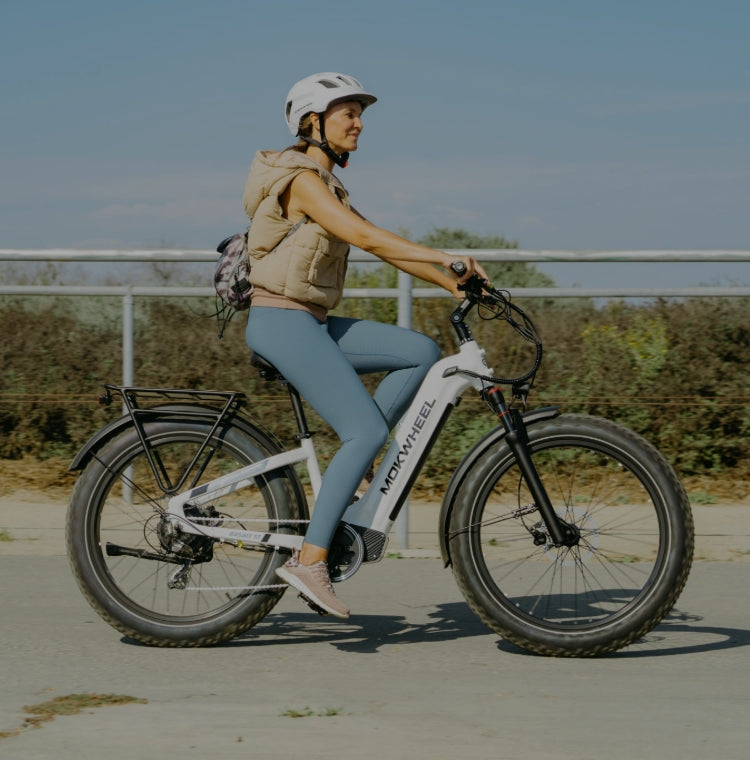


Basalt ST 2.0 Ebike


Obsidian ST 2.0 Ebike


Scoria 2.0 Ebike


Asphalt ST Ebike


FLINT PRO ST Ebike


Onyx ST Ebike


Tarmac ST Ebike


Mesa Plus ST Ebike


FLINT ST Ebike
Basalt ST 2.0 Ebike
Obsidian ST 2.0 Ebike
Scoria 2.0 Ebike
Asphalt ST Ebike
FLINT PRO ST Ebike
Onyx ST Ebike
Tarmac ST Ebike
Mesa Plus ST Ebike
FLINT ST Ebike

0% APR For 12 Months

Reliable Shipping

Quality Assurance

Secure Payment
A step-through electric bike uses a low, open frame that reduces how high you need to lift your leg when getting on or off. This design can be useful for frequent stops, everyday clothing, limited hip or knee mobility, or simply a more convenient riding routine. It is not limited to one age or gender.
Frame access is only the starting point. The best step-through ebike for you should also match your height, preferred riding position, normal terrain, carrying needs, and plans for storage or transport. A bike that is easy to mount is not automatically lightweight or easy to lift, so compare the complete bike rather than choosing by frame style alone.
Mokwheel step-through electric bikes range from lightweight city models to fat-tire and full-suspension builds. Start with where and how you expect to ride.
Start with the published rider-height range, then consider inseam, saddle adjustment, handlebar reach, and riding position. A lower frame opening makes mounting easier, but it does not guarantee that the seat, reach, or controls will fit every rider.
A lightweight step-through ebike can be useful for stairs, apartment storage, vehicle racks, or riders who regularly move the bike without motor assistance. Fat tires, larger batteries, racks, and full suspension add capability but also increase weight. Confirm that your vehicle rack is rated for the complete bike weight.
City tires generally roll more efficiently on pavement. Fat tires add traction and cushioning on gravel, grass, sand, and uneven surfaces, while full suspension adds rear-shock support for rougher routes. Tire width alone does not determine stability; pressure, rider fit, load, geometry, and surface conditions also matter.
A torque sensor changes assistance according to pedal pressure, while a cadence sensor responds when it detects the pedals turning. Neither system is automatically right for every rider. Read the cadence vs. torque sensor comparison and consider a test ride if low-speed control and assistance feel are important to you.
Published range is an estimate, not a guaranteed distance. Assist level, throttle use, hills, temperature, wind, tire pressure, rider weight, and cargo all affect real-world results. Compare expected daily mileage with usable battery capacity, and include the rider, bags, racks, and other cargo when checking payload.
The primary difference is frame access.
Neither frame type is automatically faster, safer, lighter, or more stable. Those qualities depend on the complete bike. Use our step-through vs. step-over guide for a closer comparison.
A step-through e-bike has a low or open frame, allowing you to pass a foot through the frame instead of swinging a leg over a high top tube. “Step-through” describes the frame—not the motor, sensor, speed, or terrain capability. See how this design compares with a step-over frame in Mokwheel’s step-through vs. step-over guide.
Yes. The lower opening reduces the height your leg must clear, which is useful at frequent stops or when cargo on a rear rack makes a high leg swing awkward. It does not automatically make the bike lighter or easier to balance. Total weight, saddle position, controls, and low-speed handling still determine how manageable it feels.
Yes. Compared with a step-over bike, a step-through e-bike has a lower frame opening, reducing the height and range of motion needed to get on and off. This makes mounting and dismounting more convenient for many older riders. Bike weight, fit, braking feel, and handling still matter. Explore Mokwheel’s electric bikes for seniors to compare suitable options.
No—not because of the frame style alone. Total weight depends on the frame construction, motor, battery, tires, suspension, racks, and other components. Mokwheel’s FLINT ST and belt-drive FLINT PRO ST pair 700×45C tires with 36V 10Ah batteries for lighter city handling.
In comparison, Basalt ST 2.0, Obsidian ST 2.0, and Onyx ST use 26×4.0-inch fat tires, 48V 19.6Ah batteries, and additional suspension for mixed or rougher terrain. These features add weight but also support greater payloads, traction, and ride comfort. Choose by how often you need to lift or transport the bike and where you plan to ride.
Choose FLINT ST or FLINT PRO ST when city handling, stairs, or tight storage lead the decision. Asphalt ST and Tarmac ST fit pavement-focused commuting.
Scoria 2.0 favors upright, relaxed rides, while Mesa Plus ST provides a cadence-sensor fat-tire setup at a fair price. Basalt ST 2.0 covers daily and light-trail use, Obsidian ST 2.0 adds full-suspension comfort, and Onyx ST is the mid-drive choice for steeper, rougher routes.


