










Basalt ST 2.0 Ebike


Basalt 2.0 Ebike


Obsidian ST 2.0 Ebike


Obsidian 2.0 Ebike


Scoria 2.0 Ebike


Onyx ST Ebike


Onyx Ebike

Inverter

Battery + Inverter

230W Solar Panel + Inverter


Basalt ST 2.0 Ebike


Basalt 2.0 Ebike


Obsidian ST 2.0 Ebike


Obsidian 2.0 Ebike


Scoria 2.0 Ebike


Onyx ST Ebike


Onyx Ebike


0% APR For 12 Months

Reliable Shipping

Quality Assurance

Secure Payment
What Is a Solar-Powered Electric Bike?
A solar-powered electric bike uses energy collected by a solar panel to recharge its battery. Mokwheel uses a separate foldable panel rather than mounting one on the bike frame.
After you stop, unfold the panel in direct sunlight and connect it to the correct Inverter. The Inverter manages the incoming power before it reaches the e-bike battery. You carry the solar equipment only when you need it, while the bike remains easy to ride, park, and charge normally at home with its supplied 48V 3A charger.
How Does Mokwheel Solar E-Bike Charging Work?
The system uses three compatible components:
- Foldable solar panel: The panel collects energy from sunlight. Explore the available options in the Mokwheel solar panel collection.
- Model-specific Inverter: The Mokwheel Inverter regulates the solar input before charging the battery. Select the version made for your bike family.
- Supported e-bike battery: The bike’s 48V removable battery stores energy for riding. It can also supply stored energy through the Inverter to compatible external devices.
With the 230W solar panel, Mokwheel lists about 4–5 hours to charge a supported battery in full sunlight. This is an ideal-condition estimate, not a guaranteed field time. Clouds, shade, low sun angles, high temperatures, panel position, and an interrupted period of sunlight reduce solar output and extend the charging time.
Which Mokwheel Solar E-Bike Fits Your Ride?
The seven current e-bikes in this collection share a 48V 19.6Ah removable battery, 4-inch fat tires, hydraulic disc brakes, torque-and-cadence sensing, and a listed range of up to 80 miles. Choose between them based on fit, terrain, suspension, payload, and motor placement.
- Best all-around solar-powered e-bike: Basalt 2.0 and Basalt ST 2.0
Choose Basalt if you want one bike for neighborhood rides, errands, gravel paths, grass, and light trails. Both versions use front suspension, a 750W continuous rear-hub motor with 1,100W peak output, and a 450 lb payload capacity. Choose the step-over or step-through frame according to your preferred fit and frame access. - Best compact-frame solar electric bike: Scoria 2.0
Scoria combines a low step-through frame with 20×4-inch tires and a built-in rear shelf. Its listed rider-height range is 5'0"–6'2", and its payload capacity is 350 lb. It is a practical fit when you want lower frame access and room for everyday cargo or camp supplies. - Best full-suspension solar e-bike: Obsidian 2.0 and Obsidian ST 2.0
Choose Obsidian when your routes regularly include uneven ground. Front and rear suspension absorb more movement than a front-suspension bike, while the 10-speed drivetrain gives you more gearing choices. Both frames have a listed 560 lb payload capacity. - Best mid-drive solar-powered e-bike: Onyx and Onyx ST
The Onyx mid-drive motor sends power through the drivetrain and available gears. This makes it the right choice in this collection for sustained climbing and heavier loads. Both models include full suspension, four-piston hydraulic brakes, 210Nm+ listed torque, and a 560 lb payload capacity.
Use the Mokwheel model comparison tool to check rider height, frame dimensions, bike weight, suspension, gearing, and other specifications before ordering.
Build Your E-Bike Solar Charging System
A complete solar charging setup includes:
- A compatible Mokwheel e-bike and removable battery
- A 100W or 230W foldable solar panel for e-bike charging
- The correct model-specific Inverter or solar charging bundle
- The compatible cables and adapters supplied for that combination
Do not connect the solar panel directly to the e-bike battery. The charging path is solar panel → Inverter → battery. Use the panel, Inverter version, battery, and cables listed as compatible with your exact model.
The bike, panel, and Inverter are separate products unless the selected listing clearly identifies them as a bundle.
Solar E-Bikes for Camping and Off-Grid Travel
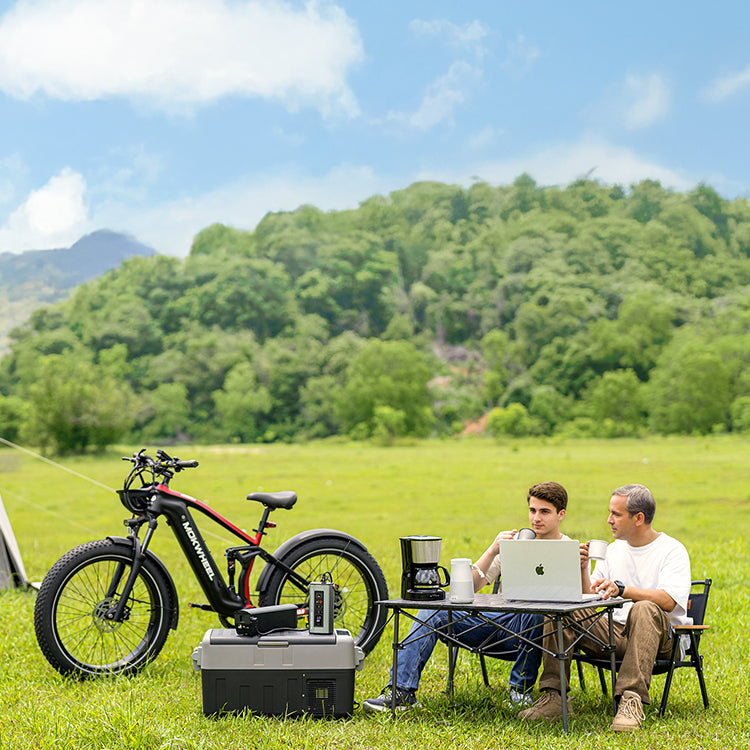
Solar charging gives you another way to replenish the battery when an outlet is not available. Set up the panel after you stop at a campsite, RV location, ranch, trailhead, or another open area with direct sunlight.
Choose Basalt for mixed everyday and weekend riding. Choose Scoria for lower frame access and cargo utility. Choose Obsidian for full-suspension comfort over rough ground. Choose Onyx when mid-drive climbing performance and higher payload capacity matter most.
Explore additional models organized around outdoor use in the Mokwheel electric bikes for camping collection.
What to Compare Before Buying a Solar Electric Bike
- Frame fit: Check rider-height recommendations, reach, saddle height, and frame access. Explore more step-through e-bikes if a lower frame is important to you.
- Suspension: Front suspension suits pavement, gravel, grass, and moderate bumps. Choose a full-suspension electric bike when rough ground is a regular part of your route.
- Motor placement: A rear-hub motor provides direct assistance at the wheel. A mid-drive e-bike uses the drivetrain and available gears.
- Payload: Include your body weight, bags, racks, tools, food, water, and camping equipment when checking the listed payload capacity.
- Transport weight: Bikes in this collection weigh approximately 77–89 lb. Confirm the weight limit of your vehicle rack before transport.
- Battery range: The models list up to 80 miles. Speed, assist level, throttle use, terrain, payload, tire pressure, temperature, wind, and elevation determine the distance you get from a charge.
- Solar compatibility: Match the panel, Inverter variant, battery, cable, and connectors to the exact bike model.
Solar-Powered E-Bike FAQs
Are solar panels built into Mokwheel e-bikes?
No. Mokwheel does not mount solar panels on the bike frame. Solar charging uses a separate foldable panel and compatible Inverter. You can leave the equipment at home for regular rides or carry it when you expect to stop somewhere without access to a wall outlet.
Can a Mokwheel solar e-bike charge while I am riding?
No. The foldable solar panel is separate from the bike and is set up after you stop. It is not a ride-mounted panel or a continuous range extender. Plan your route using the battery’s expected riding range, then use solar charging during a suitable stop.
What equipment do I need for e-bike solar charging?
You need a supported Mokwheel e-bike battery, a compatible foldable solar panel, the correct Inverter version, and the cables and adapters specified for that combination. The panel connects to the Inverter, and the Inverter connects to the battery. Do not connect the panel directly to the battery.
Can a solar panel fully charge an electric bike battery?
Yes. The compatible 230W panel and Inverter can fully charge the supported battery when they receive enough direct sunlight. Mokwheel lists about 4–5 hours in full sunlight. This published figure represents ideal conditions; inconsistent sunlight and poor panel positioning extend the charging time.
Which Mokwheel e-bikes support solar charging?
This collection includes Basalt 2.0, Basalt ST 2.0, Obsidian 2.0, Obsidian ST 2.0, Scoria 2.0, Onyx, and Onyx ST. Select the Inverter version made for your model family and confirm the complete panel, battery, cable, and connector combination before ordering.
Can the Mokwheel Inverter power outdoor devices?
Yes. The current Mokwheel Inverter lists 1,000W total AC output and 1,500W peak output. Compare both the normal operating wattage and startup wattage of your device with the Inverter limits before connecting it. Runtime depends on the battery’s remaining energy and the total connected load.
Does solar charging provide unlimited e-bike range?
No. The battery has a fixed energy capacity, and the panel needs time and sufficient sunlight to replace used energy. Treat solar charging as another charging option for planned stops. It does not replace route planning, battery monitoring, or conventional charging when an outlet is available.


